

What’s Real Anymore?
On fitness, self-development, and the quiet maturity of pulling back
Lately, I’ve been feeling off.
Not injured. Not burned out. Not lost.
Just… off.
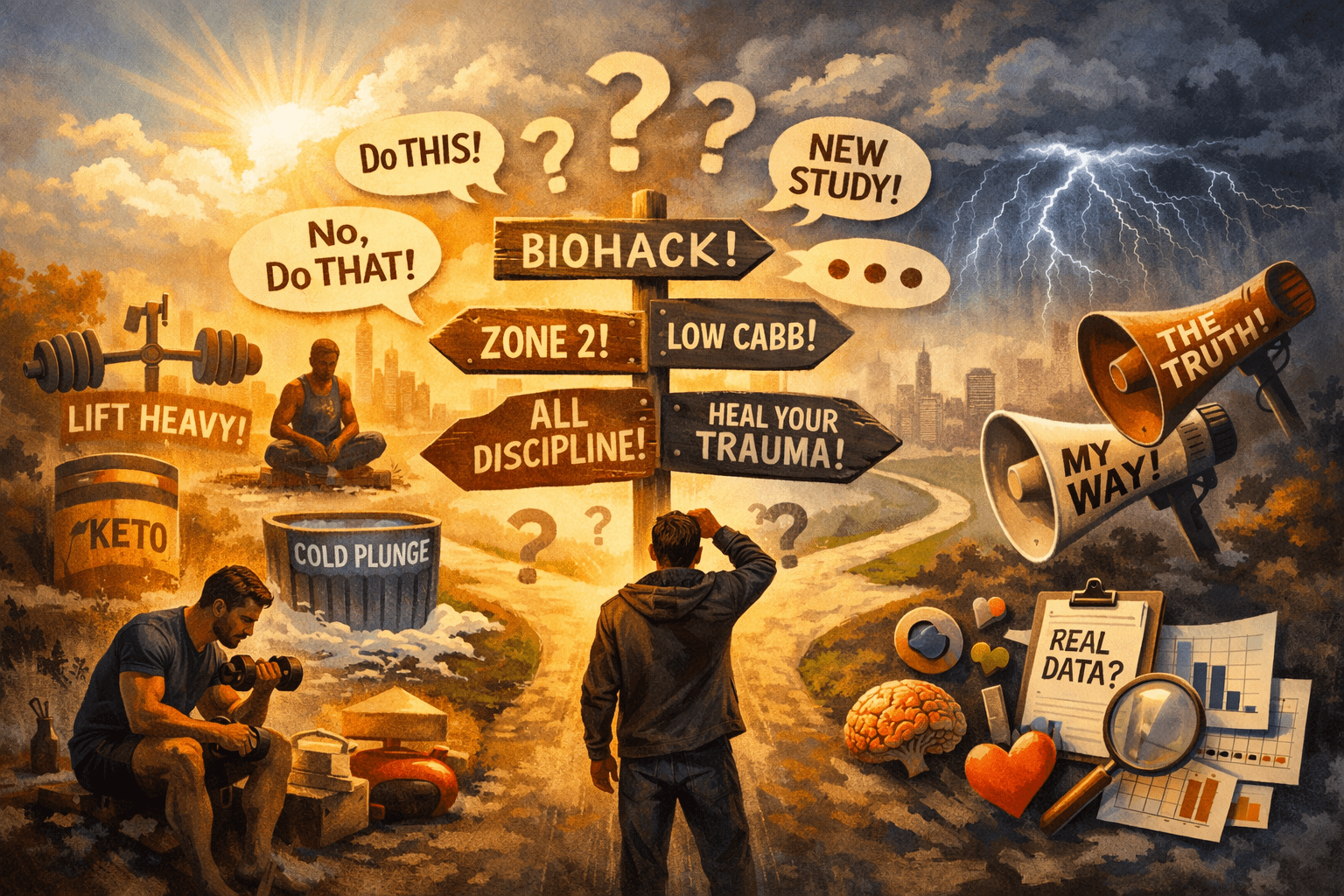
The world of personal development and fitness, which once felt electric and expansive, now feels like walking into a crowded arena where everyone is holding a microphone and swinging studies like swords. Everyone is certain. Everyone is debunking someone else. Everyone has “the truth.” And somehow, in all that volume, the signal feels thinner.
Cold plunges are either salvation or stress poison.
Zone 2 is either the foundation of human performance or a waste of time.
Lifting heavy is king. No, mobility is king. No, nervous system regulation is king.
Discipline fixes everything. No, trauma explains everything.
And increasingly, I’ve found myself asking:
What’s real in this world anymore?
If you’ve felt that too, this isn’t cynicism. It’s not weakness. It might be something deeper.
It might be maturity.
When the Magic Fades
There’s a phase most of us go through.
At first, personal development and fitness feel revolutionary. New ideas. New frameworks. New protocols. You feel empowered because you’re learning things most people around you aren’t.
You tweak your sleep.
You dial in protein.
You track VO₂ max.
You read about resilience and mindset.
You feel sharper, stronger, more intentional.
It’s intoxicating.
But then something shifts.
- Studies cherry-picked to support a brand.
- “Debunks” that are just opinions with better lighting.
- Creators building authority by tearing others down.
- Advice presenting one slice of truth while dismissing the rest.
And suddenly the magician’s trick isn’t impressive anymore.
You see the wires.
The content hasn’t necessarily changed. You have.
Your brain has moved from fascination to pattern recognition. And once you see the pattern, the illusion collapses.
The Certainty Economy
Here’s the uncomfortable reality:
Nuance does not go viral. Certainty does.
“This works for some people in certain contexts depending on stress load and recovery capacity” will never outperform:
“You’re destroying your hormones with this one mistake.”
Platforms reward clarity and conflict. Not complexity.
Balanced takes are heavy.
Extreme takes are shareable.
So creators sharpen one slice of truth and throw away the rest.
Not always because they’re malicious. Often because they’re monetized.
Fitness and self-development are no longer hobbies. They are funnels. Programs. Supplements. Coaching offers. Affiliates. Every belief has economic gravity behind it.
If your brand is built on cold exposure, you must defend cold exposure.
If your brand is built on heavy lifting, you must minimize cardio.
If your brand is built on mindset, you must downplay biology.
When identity and income attach to a protocol, nuance becomes dangerous.
And as a consumer, you feel the distortion.
The Fatigue of Tribal Thinking
Advice online isn’t just informational anymore. It’s tribal.
Keto is not just a diet. It becomes identity.
Cold exposure is not just a tool. It becomes a badge.
Biohacking is not experimentation. It becomes branding.
When identity enters, humility exits quietly.
Have you noticed how few people say “it depends”?
Instead, it’s “always” or “never.”
But life is not built on absolutes. It’s built on tradeoffs.
Cold exposure is real. So is stress overload.
Zone 2 is real. So is explosive power.
Discipline is real. So is burnout.
Mindset matters. So does sleep.
The deeper question isn’t “Who is right?”
It’s:
For who?
For what goal?
For how long?
Under what constraints?
If those questions aren’t addressed, what you’re consuming is entertainment dressed as education.
And that wears you down.
When You Start Trusting Your Own Data
Here’s something I’ve realized.
The more skin you have in the game, the less tolerant you become of oversimplification.
If you actually train consistently, you know energy fluctuates.
If you run a business, you know mindset alone doesn’t solve structural problems.
If you coach real humans, you know no protocol works universally.
You know complexity.
And when someone online speaks in total certainty, your nervous system senses the mismatch.
That discomfort isn’t disillusionment.
It’s calibration.
Because here’s what is real:
Direct experience.
When you lift consistently for twelve weeks and feel stronger, that’s real.
When you sleep badly and performance drops, that’s real.
When you stop scrolling for a week and your mind feels clearer, that’s real.
Reality is what doesn’t negotiate with your opinion.
Gravity doesn’t care about debates.
The ocean doesn’t care about biohacks.
Your body responds to stress, recovery, nutrition, and time.
But here’s the tension.
If I say “trust your own data,” isn’t that subjective?
Doesn’t that just make me another biased voice defending what worked for me?
It can.
If something works once and I turn it into doctrine, that’s ego.
If something works for me and I present it as universal law, that’s bias dressed as wisdom.
There’s a difference between blind bias and disciplined self-observation.
Bias says:
“This works. Period.”
Maturity says:
“This tends to work for me, under these conditions. It might not for you.”
That distinction matters.
When I coach people, I’m very intentional about this. I rarely say, “This is the way.” I say, “In my experience, this worked.” Or, “Research suggests this.” Or, “I’ve seen this pattern across multiple clients.” I quote other people’s experiences. I reference studies. I share anecdotes from different contexts.
Then I add the most important part:
Try it. Observe. Adjust.
Because growth is not about adopting someone else’s certainty. It’s about running intelligent experiments in your own life.
Personal data becomes dangerous when you universalize it.
It becomes powerful when you contextualize it.
And yes, I know this approach doesn’t satisfy everyone.
Some people need strong opinions. They want certainty. They want someone to say, “This is it. Do this.” Certainty feels safe. It reduces anxiety.
But that’s not my style.
And I won’t compromise my integrity to perform confidence I don’t actually have.
I would rather offer calibrated guidance than dramatic authority.
That might grow slower.
It might attract fewer followers.
But it feels aligned.
And alignment, in the long run, is more sustainable than performance.
What Actually Survives Over Time
If you zoom out far enough, a pattern emerges.
The ideas that survive across decades and centuries are not flashy.
They’re durable.
Move daily.
Lift something challenging.
Sleep well.
Eat mostly real food.
Build strong relationships.
Do meaningful work.
Spend time outside.
No dramatic headline. No viral hook.
Just repetition across time.
The internet amplifies novelty.
Life rewards consistency.
So maybe the real problem isn’t that nothing is true.
Maybe it’s that too many partial truths are presented as universal laws.
Pulling Away Isn’t Rejection
When I started feeling this way, my first impulse was to pull away completely.
Unfollow everyone.
Stop consuming anything in the space.
Opt out.
But there’s a difference between reactive withdrawal and strategic reduction.
If you quit because you’re disgusted, that’s reaction.
If you reduce because you want cleaner input, that’s maturity.
Think of it like a deload in training.
When your program gets filled with junk volume, you don’t abandon training. You remove unnecessary noise and keep what matters.
Your mind deserves the same respect.
Instead of asking, “Who’s right?”
Ask, “What’s useful here?”
Instead of building a worldview from short clips, build it from lived feedback.
Social media can be a spark. It is a terrible furnace.
What’s Real?
Here’s where I’ve landed.
What’s real is:
- Your body’s feedback.
- Your consistency across time.
- Your relationships.
- Your sleep.
- Your emotional regulation.
- Your willingness to adjust.
- Your humility in the face of complexity.
What’s real is that progress compounds quietly.
What’s real is that extreme claims rarely survive long-term testing.
What’s real is that certainty is often performance, while probabilistic thinking is strength.
Maybe what feels like disillusionment is actually graduation.
Graduation from hype.
Graduation from certainty addiction.
Graduation from tribal thinking.
The internet will keep shouting.
Your body will keep responding to stress and recovery.
Time will keep filtering what works.
And maybe the better question isn’t:
“What’s real in this world?”
Maybe it’s:
“What has quietly proven itself true in my own life, again and again, without needing applause?”
Start there.
That’s solid ground.
If this resonates, we should talk.
The same noise that clutters fitness and self-development clutters everything else — career decisions, leadership identity, what success is supposed to look like at this stage of your life.
At The Reset, we cut through it. Five days in Morocco. Small group. Real conversation. No protocols to sell you.
Just clarity on what’s actually working in your life — and what quietly stopped a while ago.
Apply for The Reset →